Saturday, February 18, 2023

First Ride of the Season


(I sold my motorcycle today and felt a little sad. I've owned a lot of bikes, but this one was easily one of the best, and it made me think of a piece I wrote once about the joy of motorcycling...) 


 First Ride of the Season Day

If we ever needed another holiday, my vote would be for “First Ride of the Season Day” for getting out of the house on a bicycle, skateboard, horse, hang-glider, motorcycle or anything fun after a season of snow and cold.


I celebrated my own First Ride on Feb. 25, heading north on Interstate 69 from the exit near Community North Hospital in Indianapolis on a Honda Shadow, a middleweight Harley-looking motorcycle, low and lean, black and gleaming chrome. I slipped into the northbound afternoon rush hour traffic at just over 70 mph on the 10-lane highway. The First Ride requires no particular destination, and the interstate is the safest place you can be on a bike, for my money: There are no deadly intersections or cars suddenly turning in front of you, just a good place to wind out the engine and air out the soul, even for only half an hour.  


Motorcycling requires a lot of focus, even while you’re relaxing. It’s far more dangerous than driving a car, and the people who ride the most usually wear excellent protective gear, ride sober, and think about safety. As with pilots, there are old riders and bold riders, but few old, bold riders. 


I use “riders” as opposed to bikers as a default because it’s an all-inclusive term, of which “bikers” are a subset. The biker image is one of the most recognizable icons in America - the leather-wearing,  hard-living motorcycle guys (often men), whose rumbling machines are so distinctive. Harley Davidson is the largest selling motorcycle brand, but at only 30 percent of sales, it is far outnumbered by Honda, Yamaha, Kawasaki, Suzuki, and other bikes. And old-school bikers look down on many of the newest Harley riders, so called “Rich Urban Bikers” who don’t actually ride much and are thought to own their machines just to occasionally look cool astride a hog.


Real riders, on the other hand, yearn for the open road. Indy’s BMW club, which I joined for a while after buying a K1200 RS, includes owners who think nothing of a quick group ride for a camping trip in the next state – or much further. They dress for safety, often work on their own bikes and live to ride, meaning they’ll get out for a head-clearing cruise down the interstate, if nothing else; or maybe a 50-mile lap around the I-465 Indianapolis perimeter just to feel the wind.


You can spot the different types of riders by what they’re piloting. There are “cruiser” bikes, a classic style most popular from the 1930s to the 1960s, with a relaxed riding position, a low seat and an emphasis on comfort. Honda cruisers, like my Shadow Aero, aren’t regarded as cool by some folks, but they’re extremely affordable and reliable, with shaft drive (instead of a chain, which must be lubricated and maintained), and a long-lasting, liquid-cooled engine. What the practical riders know is that once you’re on the road, reliability and comfort matter most of all. The choppers of “Easy Rider,” the most famous biker film of all, look cool but would be excruciatingly bone-jarring rides to actually take on a cross-country trip – all style, no suspension.


“Standard” bikes come in all engine sizes but look different, with the rider sitting upright instead of leaned back, as on a cruiser. 


Sport bikes place an emphasis on engine performance and handling. They’re the fastest, often favored by younger riders, and are ridden in a forward leaning position that’s uncomfortable for more than 40 minutes. But they’re fast, sometimes fatally so, and often known as crotch rockets. 


Baggers are heavy touring bikes – the Honda Goldwings, larger BMWs, and other road bikes with detachable, suitcase-like bags for travel. They’re the heaviest bikes - often 700 pounds, twice the weight of a little commuter bike. They typically feature the most radios and other technology, and are ridden by the oldest riders. 


While many motorcyclists prefer full-face helmets with tinted visors, it’s not hard to get a look at who’s riding as a group. Statistics from the Motorcycle Industry Council show a growing number of female and college-educated riders, but bikes are still a niche – only 8 percent of households have a motorcycle. And the most recent data shows: 


-       81 percent of owners are men.

-       Their median age is increasing, to age 50.

-       Sixty-eight percent are married.

-       Fewer than a quarter have college degrees.


Riders in a hurry take the passing lane, but I prefer the slow lane, enjoying the clouds, and countryside, but moving with the flow, watching the traffic for sudden lane changes, and the road for debris and potholes as we pass through Indy’s northern suburbs. My bike has a 750 cc engine – once considered large, but nowadays merely average. It’s easy to ride, comfortable, extremely affordable, durable, and dependable. If it were a car, it would be a Toyota Corolla. 


Riders sometimes have difficulty describing why they love their bikes. Imagine going down the road, sitting out on the hood of your car instead of inside, with a clear view in any direction, smelling the trees in the summer and feeling the cold breath of the moist low-lying air when you cross a bridge over a stream; leaning into turns in the winding, plunging roads of the Hoosier National Forest. Or the steady hum of the highway – you’re sitting on the engine – with a low bass note like the far left side of a piano, a vibration to make you forget about whatever’s wrong and just feel the right - the air, sky, rushing road beneath your feet. You’re flying, at ground level.


Veteran riders dress for a crash ("Enjoy the ride, but dress for the slide") – heavy boots, gloves, padded jackets and pants. Everybody goes down sooner or later, they say. My only crash happened in South Bend when my little Honda 350 slipped on gravel in a suburban intersection and went out from beneath me at low speed. Nothing hurt but some bruised pride. But everybody’s had their more serious close calls. A woman once turned left in front of me unexpectedly on a busy four-lane road near a shopping mall, and I went into a sideways skid, slowing enough to avoid a collision. 


When riders get together, we talk about our close calls. Here’s mine: One time I was coming down Indiana 67 south of Pendleton, a two-lane highway that runs past the coiled concertina wire of three state prison facilities and then joins the countryside heading toward Fortville. The highway parallels a rail line, and on one summer day, driving a big Honda Goldwing, I looked over to realize I was running at the same speed as a freight train about 50 yards to my right. This is a view of a train you never see - the engineer leaning out of the cab, practically next to you, and at the exact speed you’re going. I was marveling at that view, thinking how this was what riding was all about, when I glanced back at the road. Directly in front of me was a stopped cargo van, waiting to make a left turn. At the last possible moment, maybe half a heartbeat, I whipped around the right side of the van onto the berm and then back onto the highway. Hitting a stopped vehicle at 60 mph would ruin your whole day, as the old guys would say. I thought about that a lot and remember it when I’m tempted to geek out on the views.  


I think about safety all the time now and advise people thinking about getting a bike to first take the Basic Rider Course from the Motorcycle Safety Foundation. Riders in Indiana need a driver’s license motorcycle endorsement, which requires a written test and a skills test to show they can handle a bike. One of the biggest mistakes new riders make is buying a machine too large for their ability. I know a guy who misjudged his speed pulling a Harley Fat Boy into his garage; riding at such a low speed can be difficult, and the giant bike tipped over with him under it. Though he wasn’t injured he had to call his brother to come get him out.


Any motorcycle course would be better than the way I learned, at a joint called Bob’s Surf Shop on the Gulf in Biloxi, Mississippi. I got my Mississippi driver’s license at age 15, and that was enough to rent a small motorcycle at Bob’s, a place that was popular with airmen from nearby Keesler Air Force Base. They didn’t ask many questions after taking your driver’s license and the signed copies of the waiver you didn’t read. Here’s a rough summary of my first motorcycle lesson:

“See that key? You turn that on. OK, good. That green light? That’s your neutral light. Be sure you’re in neutral before you start her up, or the thing will jerk away from you. The clutch is here on the left. On your right side is the front brake and the starter button. The gear shift is there at your left foot – one down, four up – and the back brake is at your right foot. Got it? OK, be careful.”


I did OK, meaning that after some practice on a nearby quiet street I was bombing down Highway 90 along the beach. All the controls eventually become second nature, but the only way to become a good rider is to ride a lot. There are many low mileage, used bikes out there, sold by people who decided maybe they didn’t want to be a rebel, after all.

They were riding for the wrong reason. It’s not about looking cool. It’s about the First Ride of the Season, and then the rest of the Saturdays through October, finding the back roads, the green scenery on the Ohio River, meeting up with friends. You wait all winter for that. And then when the snow finally melts and temps get into the 40s, you can feel it in the air – time to gas up and take off.

Want to go for a ride? Here’s a short video of what it’s like aboard my bike.


Tuesday, February 7, 2023

Rock Steady Boxing: Exercise club for Parkinson’s patients helps many with movement—and hope

I did this feature story about a local group that's doing some amazing work. It's always good when you come away inspired from meeting people...


    Frank Pulice dropped his left shoulder and delivered a well-timed combination to the heavy bag swinging in front of him at a North Shadeland boxing gym. He recently put on boxing gloves for the first time in decades, but his opponent now isn’t another teenager. It’s the progressive disease he has in common with Muhammad Ali and Michael J. Fox. 

    Frank has Parkinson’s disease, and like thousands of other patients, he’s found help at Rock Steady Boxing, the national exercise club with a North Shadeland gym that helps many Parkinson’s patients with movement—and hope—through a non-contact, boxing-based fitness program.

MORE: https://northshadeland.com/rock-steady-boxing-indianapolis/


Saturday, December 10, 2022

Nobody Was Injured in the Making of This Video


Standing next to a furnace of melted glass at 2,100 degrees was more than warm enough on a chilly day as our team from work got our introduction to this fascinating art. I teach phone-based video shooting and editing and enjoy making little projects like this. If you get the chance, GRT Hot Glass Studios in Indy is a fun place.


Thursday, December 8, 2022

Happy Places

I woke up one morning in Monument Valley and took this photo of the sunrise. Took the image to a printer and made a nice big copy for the wall in my room. Makes me happy to linger on that moment.


Looking for places to fly


I've had fun riding out into the country on my motorcycle and finding interesting places for aerial videography. I got my FAA commercial drone license a few years ago and use these trips for practice--and peaceful outings away from the city. I'm a former student pilot and this piece really gives the feel of what it's like to soar over the landscape and then dip down for a closer look.  

0-0

My family lives on a mountain in Tennessee, and I did this piece about my sister's garden. I liked using the high-angle view from the drone sparingly, but to pretty good effect.


Sunday, August 28, 2022

TikTok, News and The Washington Post

I’m fascinated by TikTok and what its startling growth implies for online reporters and editors. Some recent data points:  

“The app came into its own as a news-gathering and presenting tool in the early days of Russia’s invasion of Ukraine. Ordinary Ukrainians picked up their smartphones and documented the atrocities of the Russian regime, their footage viewed nearly a million times a minute in the war’s early days. 

“The reality is that TikTok is where the audience is these days: a billion worldwide. So it makes sense for news outlets to be there too. The BBC has, for at least a decade or more, been seeking an audience of “replenishers” – W1A speak for younger viewers and listeners to replace the old, dying audience it currently has. (The average age of a BBC One and BBC Two viewer is well north of 60, according to the BBC’s director general, Tim Davie.) So far, it has done so relatively unsuccessfully.” (1)

      Usage is higher among people 18–24, and much higher in parts of Latin America, Asia, and Africa than it is in the United States or Northern Europe. (2)

     There’s still a relatively short list of U.S. news publishers on the platform, including The Washington Post, USA Today, PBS stations including WGBH,WBUR, YahooNews, Vice News.(3)

     The Washington Post, for example, has 1.4 million followers, with its most popular posts including pieces on monkeypox (137,000 views), student loan forgiveness (144,000) and controlled-burning in forests (211,000).(4)

     The Post’s TikTok efforts are led by Senior Video Reporter Dave Jorgenson, a graduate of DePauw University in English who launched the paper’s channel in 2019. Presented here are two samples of his work. Notice the two approaches, typical of the experimentation you would expect as we figure out how best to connect with audiences.

     The student loan piece (above) from Aug. 18 has racked up nearly 900,000 views with a 10 percent engagement rate – the number of likes, shares, etc., over the number of total views. By comparison, the average on Twitter posts is closer to 0.5 percent.(5)

     Check out the sophisticated production, with Jorgenson playing both parts as two people discuss repayments, complete with reaction shots. And besides the information itself, there’s a point of view: At the end, the person with debt is Googling up a question very much on the mind of skeptical, younger students today: “Was going to college a bad idea?”

    A more recent Jorgenson piece, published Aug. 27, takes another approach. The description line says, “Want to give your phone battery a long life? The Post talked to scientists who study lithium batteries. Here’s some tips.” 

    What follows is a frenetic take on a Jack Black “School of Rock” moment as the backdrop for information about making cellphone batteries last longer. After only one day, the piece had more than 97,000 views and an engagement rate of 14 percent.


     After watching these you may wonder, is this news? Set aside the format for a moment, and think about how the material relates to the time-honored seven values we use for evaluating newsworthiness(6).

A better question: Is it worth the effort? WaPo’s TikToks don’t link back to the newspaper’s web site, and don’t generate revenue, so a fair question would be to ask what the goal is, and how does this contribute to their success. One answer: As newsrooms seek to replace readers who are aging out, and trying to underscore their usefulness and relevance, they have to turn to the strategy we’ve always used: Meet the readers where they are, not necessarily where you’d like them to be.

    Your thoughts are welcome.


(1)  TikTok is not the enemy of journalism. It’s just a new way of reaching people

https://www.theguardian.com/commentisfree/2022/jul/23/tiktok-journalism-news-outlet-journalism-media


(2)  Overview and key findings of the 2022 Digital News Report

https://reutersinstitute.politics.ox.ac.uk/digital-news-report/2022/dnr-executive-summary


(3)  Here’s a running list of publishers and journalists on TikTok | Nieman Journalism Lab

https://www.niemanlab.org/reading/heres-a-running-list-of-publishers-and-journalists-on-tiktok/


(4)  Washington Post TikTok

https://www.tiktok.com/@washingtonpost


(5)  Your guide to social media engagement rates

https://www.adobe.com/express/learn/blog/what-is-a-good-social-media-engagement-rate


(6)  These 7 news values can help you make smarter content choices

https://medium.com/atlantic-57/these-7-news-values-can-help-you-make-smarter-content-choices-6b3cbc0bddf7

Friday, August 12, 2022

Gannett layoffs: Relief for newspapers could be years away

Unsplash/Luis Cortes
Aug. 12 was a dark day for many newsrooms across the country, as Gannett Co. Inc. began another massive round of layoffs. 

I'm a former Gannett reporter/editor (Indianapolis Star) who left to teach college journalism in 2008, a couple years after total newspaper revenue peaked at $49 billion. In the most recent (2020) data from Pew Research(1), that number was $9 billion, or a decline of more than 80 percent. A good guess is that the decline will continue at least until 2026 when rising digital revenue stops the bleeding.(2)   

What does this mean for online reporters and editors? As word of Friday's layoffs spread(3,4), we should note that there are many jobs in news and other communications fields. Even newspapers are still hiring, as staffers from the Atlanta Journal-Constitution and other outlets pointed out(4). TV news operations are dying for producers and web editors, jobs where excellent writing skills command big respect.  

But anyone considering a big change--even if they haven't been laid off--should look things over carefully, reach out to trusted networks and think about where communications and jobs are heading.

If you've been laid off, consider this advice from the Harvard Business Review(5): Take a hiatus, Get a handle on where you stand financially, Talk to trusted friends, Surround yourself with positivity, Tend to your well being. Like most advice offered to people in crisis, it's easier to say it than do it. So the rest of us can help by reaching out, listening, and being there for friends feeling this punch.

(1) Newspaper Fact Sheet, Pew Research
https://lnkd.in/gwT9hSyu

(2) U.S. digital newspaper ad revenue expected to surpass print by 2026
https://lnkd.in/gkMqFvxP

(3) Gannett lays off journalists after dismal second quarter results
https://lnkd.in/gETgrFnX

(4) Twitter - Gannett
https://lnkd.in/gJpBeDAc

(5) How to Bounce Back After Getting Laid Off
https://lnkd.in/gmxSRUcq

-30-

Thursday, August 5, 2021

My walking obsession, or "Did I tell you about the time….'


 Hot days, cold days - every day's a walking day when you're determined not to miss. 


My friend Coogan looked at me for a minute, a slice of pizza stopping just short of his chin.

“You did what?”

“I walked today,” I said, not sure what he meant. Coogan noticed the pizza again, took an absentminded bite and continued, speaking around a thin-crusted mouthful of pepperoni and cheese.

“I mean – what was the other part? The days or something.”

“Oh, this was Day 3,123.”

“Of what?”

“That’s how many days I’ve walked without a miss.”

Now he was remembering. My friends usually know better. This happens when you talk to a fanatic. A golfer can recount every swing on a cloudy 18-hole Saturday. Pilots grow  rhapsodic about the view from above, the beauty of a surging stratocumulus. I knew a basket collector who could hold the floor for an hour if no one collapsed or jumped out a window. The truth is, I know better than to bring up my personal obsession, but if they ask me…

“That’s right,” Coogan said, remembering too late. “The streak.”

“Well, no big deal,” I said. “It’s now – “ I had pulled out my phone where I keep the log that has grown, at least one mile per day, since Sept. 6, 2012.

“As of today, it’s 8,378 miles without a day off.” Not smug or overly self-satisfied - just sounded that way.

Coogan turned his attention to the pizza box between us, hunting for one of the small rectangles in the flickering light of the gas fire pit. We were on my deck on a Saturday night, stars just coming out, nobody around but a dog barking for company, two yards over.

We were in school together a long time ago and have teamed up for a few trips and football games over the years. Now he was my guest, driving back from seeing Glenn in New Mexico, headed home to D.C., and just stopping by for the night. He had pizza, the fire, and a break from the road, so maybe he felt the need to play along.

“How’s that going?”

“Oh, the walking? Yeah, I’m at (consulting the phone record again) 3.0335 average miles per day on the streak.”

“Yeah?”

“That’s for the streak, of course. For this year, I’m at 3.8235.”

Coogan yawned. Guess it had been a long day.

“That’s good,” he said.

“Not all the time,” I said, finding a square he had missed in the box. “I told you about the duck, right?”

“The time that duck was taking off as you jogged by and it crashed into your leg?”

“Yeah, that was weird. A mallard. He was fine, maybe a little wobbly when he took off again. I imagined him telling the other ducks later: “It was a beast, I tell you, nine feet tall at least, and running at me….”

“But you survived,” said Coogan, staring into the fire.

I ignored that.

In my phone’s Notes app is a record, updated with each day’s mileage, and average steps for each month. I don’t know why I count the steps, too. People are funny, I guess. If Coogan wasn’t so tired, he’d probably want to know about some of my top days, like December 26, 2018 – 18,773 steps, sir. But that’s only about seven miles for me, and I know I had a few longer days – oh wait, here we are: 10 miles on April 18, 2020; nine miles on May 26 that year; a few eight-mile days in July, August, and November of 2019.

I continued looking through the log. People don’t always show it, but you can tell they’re secretly grateful to hear about these exploits.

“Ah, here we go - the list of cities where I’ve run or walked. We didn’t do business trips last year, but in 2019 I did Austin, Detroit, Richmond, and San Francisco. Year before that: DC, Denver, New York, LA….”

It’s hard to be humble with that record, but I don’t like to brag.

“Yeah, that’s great,” Coogan said. He wasn’t planning to travel until things settled down but had talked about getting back to Zambia.

When we got out of school Coogan spent a tour in the Peace Corps, working on development projects in west Africa. He came back home and hitchhiked all over the country for a few months before picking up a Yale MBA, becoming a senior vice president with a large retail company and then going back to Africa again for a U.S. agency. He’s visited more than 80 countries and can tell you about the second-longest plane ride in the world, 18 hours from Washington to Johannesburg. That’s almost as long as the ride from Singapore to Newark, New Jersey. He’s soft-spoken, very well-read, and now semi-retired. He hikes a lot and has done a good chunk of the Appalachian Trail.

My handful of cities didn’t seem to register, but he was polite.

“Where do you walk around here?”

Nothing as interesting as the Appalachian Trail, though Fort Harrison State Park is about 10 minutes away and has some pretty interesting trails, yes sir.

“Mostly here in the neighborhood,” I said. Fact is, I just get my miles done wherever I can, usually listening to a podcast or a book. To stay out of traffic I’ll do laps around the local high school parking lot, seven-tenths of a mile per lap.

As walking adventures go, it’s been a quiet career, marked more by what some friends unfairly call a questionable obsession with record-keeping than with fully embracing the gifts of nature, the kiss of a cool spring morning, all that stuff.

But I’ve got the log. Coldest day: Minus 7 on Jan. 8, 2015. Now that was a morning. And it was 1 degree on Dec. 27, 2017. Probably a four-sweater walk.

Hottest day: June 26, 2017 in Phoenix, where it was 93 degrees at 6:30 a.m. But it’s a dry heat.

Earliest? A 3 a.m. run before an early flight to San Francisco.

It’s been a life of adventure, sure, but Coogan was a little tired.

“I told you about the dog, right?” This was a harrowing experience, enough to turn a person’s blood cold, surely.

“The time you got bit by a dog in the neighborhood, and he knocked you down?”

“Well, he didn’t knock me down, exactly. He just startled me a little and I was backing up, and --.”

“And you fell.”

“Well yeah, he came out of nowhere. Usually, he was kept in by an invisible fence, but this time he just charged right out.”

“Charged you?”

“Yeah.”

“Bit you, huh?”

“Yeah,” I said. “They had to come out and call him off.”

“Who was that?”

“Some kid whose dog it was.”

“A kid?”

“Yeah, a little guy. He comes out and says, ‘Pepper, get over here!’”

Coogan was still staring at the fire, but he shifted a little and looked for his glass on the table next to us.

“Let me see if I got this right,” he said. “You’re out running, and you’re attacked by a dog.”

“Right.”

“And a little kid comes out, and he saves you from – Pepper, was it?”

“Well…”

“The little kid saved you.”

“Yeah, but...”

“From ‘Pepper.’”

“Just came out of nowhere, it was wild.”

“Yeah, good thing you weren’t killed.”

“Yeah, well you weren’t there, Bub. Pepper was a violent offender.”

Coogan hid it well, but underneath I’m sure he was impressed. We’re both seasoned citizens of the world, I guess you would say. He looked into the fire and yawned.

“Well,” he said. “You’ve had some adventures, that’s for sure.”

- John Strauss, 2021


Sunday, January 17, 2021

I'm pretty sure God wants you to get vaccinated


Nobody should have to say this, but if you get the chance to take the COVID vaccine, do it. 

I have a sister who joined other retired healthcare workers to help fight the pandemic. They would pay her, but she's volunteering. A nephew is on the front lines as a physician at Grady Memorial Hospital in Atlanta.

And then there's an old friend of mine, in his 70s, with children and grandchildren, an active person and avid softball player. People his age can now get the vaccine in Indiana, and I told him that it was good to know he could get the shot.

But no.

"I'm not into taking shots I don't need," he wrote me, adding one of his trademark baseball references:

"If God is ready to call me up to the Parent Club, I'm not going to work to stay down here in the Minor Leagues."

This is where we've arrived in 2021: Death by lying. The enemies of truth insisted that COVID was a hoax, that it would disappear, that precautions weren't necessary. They knitted this with other threads of fabrication about the media, elections, and truth itself.

And so across the country, as we fight to get the lifesaving vaccine into the arms of the most vulnerable, there will be holdouts. It's OK to be cautious, of course. But people who refuse to protect themselves risk not only their own health, but will strain an overburdened healthcare system if they get sick.

You're a patriot, I told my friend. Do it for your country, your community. Do it so you don't catch this virus and spread it to others.  

Yes, the Good Lord will call you when it's time - but he gave us the smarts to create life-saving medicine. That's part of the plan. We need you, my friend. Please think about being there for us.

(Photo: Health.gov)


Sunday, January 27, 2019

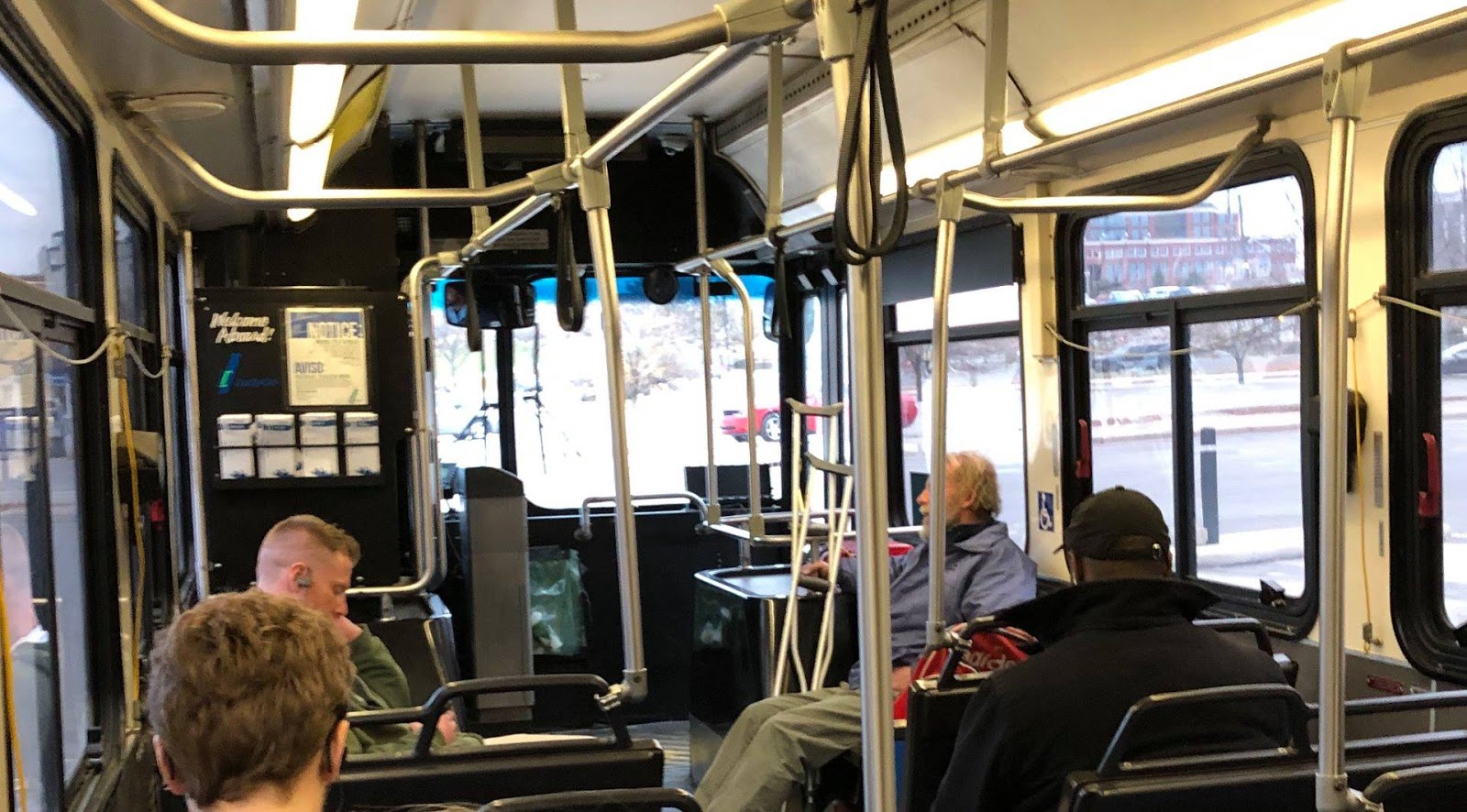
Think your commute is rough? Try driving a bus


It’s not easy being a bus driver, but Bob is glad to have the job.

 “I started with IndyGo after driving tractor-trailers from New York to California. I got tired of being on the road as a truck driver,” he said recently, steering his bus near the end of his route. I’m not using Bob’s real name so he can speak freely, but he’s a friendly guy who enjoys the job and is nice to the passengers.

“I wanted to be home with my family instead of being on the road,” he said. “So when I got into this game it was like, OK, instead of being in a hurry all the time like when you’re driving a truck, I could take my time and take care of the passengers. As Jackie Gleason said, ‘How sweet it is.’”

IndyGo is looking for coach operators as it prepares to start the new Red Line this year and implement a 70 percent expansion in service. The job isn’t for everybody, and the numbers show it. The bus company had 682 total employees at the end of 2018, nearly 20 percent below capacity. In November, the company hired 10 people but lost 11. In December, three left and none were hired, according to a report to the IndyGo board at its January meeting.

The number of drivers isn’t broken out in the report, but Bob and other coach operators say they lose a lot of new hires because dealing with city traffic and angry passengers can be stressful. One woman told me about a passenger dumping a drink on her during a discussion. IndyGo takes passenger complaints seriously, and drivers dread getting written up.

Complaints peak during the summer, maybe because the heat frays everyone’s nerves. July and August saw about 360 complaints each, around double the lowest month, December. Most of the complaints are about “pass-bys,” when the bus doesn’t stop to pick someone up. In their defense, drivers sometimes find it hard to see a person standing in dark clothing at night. Some bus stops cover multiple routes and if someone’s not standing by the sign, a driver might think they’re waiting for a different bus.

IndyGo drivers see a lot. Bob was at a stop light once and looked down to see the driver next to him texting on her phone. The light changed, and her car didn’t move. Bob started to pull away when another car slammed into the woman next to him. He hit his four-ways and pulled over to see if he could help. Both of the other drivers got out of their cars to check the damage - and both were still on their phones, texting.

“You have to laugh sometimes, but it’s also scary,” he said. “We take safety very seriously. People have no idea what we see out here.”

Every organization has problems, but if you ride the bus system in Indy you’ll generally encounter friendly drivers, and will hear riders say “thanks” as they step out the door.

There’s a comment line for riders to speak up. It got 375 total calls in December, including 14 compliments. Most of us never think to jot down a driver number and register a compliment, but maybe we ought to. The number is 317-635-3344.

Indy's paratransit service better, but not there yet


Some good news at last night’s IndyGo board meeting about Open Door.

The Indianapolis paratransit service was running at an on-time rate of 89 percent at the end of December, according to Roscoe Brown, Vice President of operations. That’s compared with 65 percent in August.

WTHR-TV reported in November that the bus company had withheld $960,307 in payments to contractor Transdev for poor service.

Brown said IndyGo has withheld October payments, but released payments for November and December “minus liquidated damages.” Transdev is on track to achieve its contract goal of 95 percent on-time performance, Brown said.

A representative for the company said the improvements had been achieved by adjusting the “run-cut,” or drive scheduling. Peak demand time for Open Door is 7-8 a.m., but most of the drivers were starting work at 9 a.m.

“They had already missed the party,” the representative told board members.

IndyGo is issuing an RFP to look at best practices for providing paratransit service and to make recommendations for improving Open Door. Board members will also be visiting the Transdev operation to better understand how it functions, Brown said.

Elsewhere, President and CEO Michael A. Terry, announced that he is departing the agency.

“After 15 years of service, I’m going to be leaving,” he told the board. “It’s time. The organization is in excellent shape and it’s time to pass the baton.”

Terry, a 1974 graduate of DePauw University, previously was a deputy commissioner for the Indiana Bureau of Motor Vehicles before joining IndyGo in 2003 as Vice President for business development and marketing.

“I’m not leaving right away,” he told the board. “I’ll be here to support the search and the succession plan.”

After the meeting Terry reflected on what the job had meant to him.

“This is a mission,” he said. “We’re doing very important work for Indianapolis, and we’re making progress. That’s very good to see.”


Saturday, January 26, 2019

Looking back: the bus passenger column


Bus drivers to remember a favorite passenger -- and friend


Maude Bryant stood at a bus stop on East Washington Street, about to die.

Amid all the other traffic on that busy street, a speeding Chevy Blazer was headed her way.

She held a box of chicken from the restaurant across the street. She had a monthly bus pass. She probably had a pack of gum to give her bus driver, because that's what she liked to do.

It was just before 2 p.m. on Saturday.

What happened next, you may have seen in the news -- the 76-year-old woman run down on the sidewalk, and the SUV driver charged with reckless homicide and causing a traffic death while intoxicated.

This is about what happened before Saturday.

Maude was her name, but everybody called her Sam. She had the mental capacity of a 12-year-old. You could call that a deficiency, but friends saw instead the smile and enthusiasm of a happy child.

Some of her best friends were city bus drivers. She rode the bus just to have something to do sometimes, and they looked after her.

When Sam had trouble handling her money, driver Jeannie Kemerly stepped in. She organized things and put Sam on a budget, so she could live on her own and not have to go to an institution.

Sam became an honorary member of the family. Because Kemerly's three daughters had boys' nicknames -- Charlie, Oscar and George -- she wanted one, too. And that's how she became Sam.

When Kemerly died last year, one of her daughters, Cheryl Yarnell, took over as unofficial guardian, helping Sam remain independent.

On Thanksgiving and Easter, Sam could usually be found at the home of another IndyGo driver, Rhuperdia Chandler.

"I try to help everybody, but I loved Sam. She was family," Chandler said. "She loved everybody. I've never known anybody like her before."

Chandler heard about the crash while getting ready for church Sunday morning. IndyGo called her at home because police were contacting Sam's family of bus drivers trying to find the woman's real relatives.

She does have a brother and a sister. But both are in other cities and in poor health. So bus drivers were pitching in for a memorial service today.

It's at Shirley Brothers Irving Hill Chapel, 5377 E. Washington St. Visitation is from 5 p.m. to 7 p.m., with a memorial service at 7.

That's only a block from the spot where Sam died. Friends have put up some red and pink artificial flowers and a toy mouse on a utility pole.

Sam had been standing next to the pole, waiting for her bus. The impact from the Blazer knocked her 60 feet. The thought of that made it hard for Chandler to sleep this week. More than anything, she hoped that Sam didn't suffer. Maybe, she hoped, her friend never even saw the truck.

Police said the Blazer was traveling at least 51 mph -- 75 feet per second.

It went onto the sidewalk just a few feet before the pole. In other words, everything happened in a split second.

In a cloud with no silver lining, the friends of Sam had to settle for this:

She lived a good life. Then, thank God, it ended before she knew it.


By John Strauss
The Indianapolis Star
May 2, 2003
 

Thursday, January 24, 2019

Driving in the demolition derby


(This was a first-person sidebar to a national story on derbies, the kind of crazy night on the job that sticks with you a long time later. When I was an AP correspondent, the occasional feature like this was a welcome break from some of the serious coverage of disasters we were often assigned. (A look at some more typical stories: http://tcom610.blogspot.com/2011/01/some-of-my-stories.html)

Novice drive takes his shot in demolition derby at fair

(John Strauss, the AP’s Evansville correspondent, drove a demolition derby car at the Posey County Fair and lived to write about it.)

NEW HARMONY, Ind. – Joe Downs had the car ready for the demolition derby: the windows and all but one of the seats were out, the hood was lashed down good and the doors were chained shut.

“Don’t be nervous,” he said, watching me fumble with the straps on the crash helmet. “Remember, if the engine catches fire, climb out on the roof. If the fire’s inside, go out on the hood. Whatever you do, don’t get off the car or you’ll get run over.”

Some choice: Say with a flaming 1977 Dodge Monaco or try running through a dozen rampaging jalopies doing their best to wallop each other.

“Just give them a good show,” said Downs, who works at the Evansville junkyard where the car was bought for $35. He taught me the basics:

Reverse gear is important in a demolition derby. Hit other cars with the back of your car to protect your radiator. Try to bash in somebody else’s front end and take out their cooling system. With luck, you can hide in the clouds of steam from exploding radiators.

But the Monaco’s jury-rigged shift stick jammed at the start, trapping my car against the telephone poles laid down to circle the field. Off the passenger side a station wagon hurtled backwards toward me.

BAM!

The Monaco shuddered violently and then shook clear, full throttle in reverse, toward the center of the cfield with the station wagon in pursuit.

BAM!

A three-car pileup in heavy traffic near the middle killed the Dodge’s engine. The car had to be hot-wired using cables on the floor as the sedan jerked back and forth under the pounding of the battles around me.

My car’s engine finally started and I was able to get away and take a couple shots of my own. I feinted, jabbed, parried, got some good contact and started to get the feel of it.

The Dodge somehow made it to the final round but got hammered badly there, eliminated finally when the driveshaft broke on one of the telephone poles.

If there was one bright moment, one glimpse of the thrill the regular drivers get out of this mayhem, it came early on – as I scrambled to keep from being disqualified for not hitting another car within the time limit, two minutes.

As the announcer was telling the crowd I only had seconds to go, the Dodge leapt forward, picking up speed toward a slow-moving car 40 yards away.

Time was almost out. The crowd, knowing this was my first derby, was cheering and I felt like a high school kid sprinting for the end zone.

I made the play, creaming the station wagon head-on to stay in the game.

The crowd roared. The head-on crash wasn’t smart – but it was a good show.

Aug. 7, 1987

Wednesday, January 23, 2019

Cab driver Steve the Hippie


I went to Albuquerque in 2009 to speak to the New Mexico Press Association and met a loquacious cab driver on the way to the hotel. The creative challenge was to help tell his story. Or stories. (He had a lot to say.) Beneath the gruff, slacker exterior was a bright guy with a lot of pride in how his daughters turned out. You'll see him swallow hard after he talks about them. Next question.

Monday, January 21, 2019

Things you can learn in prison


A long night at an Indiana prison riot offered a good lesson in journalism and human relations when I was on the street years ago.

This came up recently when I came across my story dictated from a telephone booth at the Indiana Reformatory at Pendleton northeast of Indianapolis.

Here's the top:

PENDLETON, Ind. - Authorities today regained control of a prison block where knife-wielding inmates rebelled in protest of conditions, injuring five guards and holding two others hostage for more than 15 hours. A third hostage was released earlier.

The last of the guards was released shortly after midnight Friday after Department of Correction officials agreed to meet some of the prisoners' demands.

"I'm OK," said one hostage, corrections officer Carl Ingalls of New Castle, as he waited early today at the Indiana Reformatory entrance for his wife.

Five guards were hospitalized with stab wounds, with one listed in very serious condition, authorities said...


Things I remember about that now:


- Somebody told me that night that the guards at any prison only have control of the place as long as the inmates let them. The inmates generally comply because they get to run the society inside, and any rebellion usually brings a very tough response. At Pendleton that night, the inmates had enough control to force administrators to negotiate. And they figured out what conference room we in the media were filing from. Soon they began calling the phone to tell us directly about their complaints. They were smart, organized and very violent.

- For a reporter on the scene there were challenges that hardly exist today. Laptops were rare so we dictated stories and updates by telephone. You did that by assembling your notes and quotes, writing yourself a lead to get started and then weaving the rest of the narrative together as you went. That's a skill that could be helpful again today when we're talking about frequent Web updates.

- We had no cell phones, so to file an update we had to use the pay phones in the lobby (after administrators disabled the conference room phones we had been using, because the inmates were calling us). There were just three pay phones. As midnight arrived and it appeared the inmates were about to release their hostages I grabbed one of the pay phones and called my office, holding the line so I we could get the update out right away. Other reporters did not like this, so I pretended to be in a heated conversation with somebody at the other end. As soon as the last hostage was released we hit the wire in time for morning newspapers that had been holding their pages.

- Don't freak out your sources. After the prison was secured again we naturally wanted to talk to some of the correctional officers who had been held hostage. No way, administrators said. They were a bit shaken up and were still being debriefed anyway. An hour later I was still on the scene, in the tradition of wire service reporters who have to stick around well after the cycle closes in case there are questions. The TV cameras had packed up and the place was clearing out when I saw a door open and a young guy in his 20s walk out. He wore the uniform of a correctional officer but his tie was askew, his hair mussed and his face pale and haggard. I sidled up to him.

"You OK?" I said.

"Yeah, I'm OK," he replied.

"You were one of the guys they were holding hostage?" I asked gently.

He nodded and told me his name, and then we both looked up. A frantic, wild-eyed man ran up to us - one of my competitors from another wire service.

"Hey! Are you one of the prison guards?" he said in a loud voice. After the very quiet start of our chat it sounded like this guy was yelling. My guard lowered his head and mumbled that he had to go meet his wife. The interview was over.

That moment with the former hostage was brief but it made the third paragraph of our national story. It was also a great lesson in human relations. My colleague hadn't meant to blow the interview: Had he been cool and just eased into the situation we could have both gotten a first-person account from inside the riot.

The gentle touch often pays off. That's a principle that's worked in a lot of situations far from the prison over the years.

- John Strauss, jcs1122@yahoo.com