Thursday, December 8, 2022

Happy Places

I woke up one morning in Monument Valley and took this photo of the sunrise. Took the image to a printer and made a nice big copy for the wall in my room. Makes me happy to linger on that moment.


Looking for places to fly


I've had fun riding out into the country on my motorcycle and finding interesting places for aerial videography. I got my FAA commercial drone license a few years ago and use these trips for practice--and peaceful outings away from the city. I'm a former student pilot and this piece really gives the feel of what it's like to soar over the landscape and then dip down for a closer look.  

0-0

My family lives on a mountain in Tennessee, and I did this piece about my sister's garden. I liked using the high-angle view from the drone sparingly, but to pretty good effect.


Sunday, August 28, 2022

TikTok, News and The Washington Post

I’m fascinated by TikTok and what its startling growth implies for online reporters and editors. Some recent data points:  

“The app came into its own as a news-gathering and presenting tool in the early days of Russia’s invasion of Ukraine. Ordinary Ukrainians picked up their smartphones and documented the atrocities of the Russian regime, their footage viewed nearly a million times a minute in the war’s early days. 

“The reality is that TikTok is where the audience is these days: a billion worldwide. So it makes sense for news outlets to be there too. The BBC has, for at least a decade or more, been seeking an audience of “replenishers” W1A speak for younger viewers and listeners to replace the old, dying audience it currently has. (The average age of a BBC One and BBC Two viewer is well north of 60, according to the BBC’s director general, Tim Davie.) So far, it has done so relatively unsuccessfully.” (1)

      Usage is higher among people 18–24, and much higher in parts of Latin America, Asia, and Africa than it is in the United States or Northern Europe. (2)

     There’s still a relatively short list of U.S. news publishers on the platform, including The Washington Post, USA Today, PBS stations including WGBH,WBUR, YahooNews, Vice News.(3)

     The Washington Post, for example, has 1.4 million followers, with its most popular posts including pieces on monkeypox (137,000 views), student loan forgiveness (144,000) and controlled-burning in forests (211,000).(4)

     The Post’s TikTok efforts are led by Senior Video Reporter Dave Jorgenson, a graduate of DePauw University in English who launched the paper’s channel in 2019. Presented here are two samples of his work. Notice the two approaches, typical of the experimentation you would expect as we figure out how best to connect with audiences.

     The student loan piece (above) from Aug. 18 has racked up nearly 900,000 views with a 10 percent engagement rate – the number of likes, shares, etc., over the number of total views. By comparison, the average on Twitter posts is closer to 0.5 percent.(5)

     Check out the sophisticated production, with Jorgenson playing both parts as two people discuss repayments, complete with reaction shots. And besides the information itself, there’s a point of view: At the end, the person with debt is Googling up a question very much on the mind of skeptical, younger students today: “Was going to college a bad idea?”

    A more recent Jorgenson piece, published Aug. 27, takes another approach. The description line says, “Want to give your phone battery a long life? The Post talked to scientists who study lithium batteries. Here’s some tips.” 

    What follows is a frenetic take on a Jack Black “School of Rock” moment as the backdrop for information about making cellphone batteries last longer. After only one day, the piece had more than 97,000 views and an engagement rate of 14 percent.


     After watching these you may wonder, is this news? Set aside the format for a moment, and think about how the material relates to the time-honored seven values we use for evaluating newsworthiness(6).

A better question: Is it worth the effort? WaPo’s TikToks don’t link back to the newspaper’s web site, and don’t generate revenue, so a fair question would be to ask what the goal is, and how does this contribute to their success. One answer: As newsrooms seek to replace readers who are aging out, and trying to underscore their usefulness and relevance, they have to turn to the strategy we’ve always used: Meet the readers where they are, not necessarily where you’d like them to be.

    Your thoughts are welcome.


(1)  TikTok is not the enemy of journalism. It’s just a new way of reaching people

https://www.theguardian.com/commentisfree/2022/jul/23/tiktok-journalism-news-outlet-journalism-media


(2)  Overview and key findings of the 2022 Digital News Report

https://reutersinstitute.politics.ox.ac.uk/digital-news-report/2022/dnr-executive-summary


(3)  Here’s a running list of publishers and journalists on TikTok | Nieman Journalism Lab

https://www.niemanlab.org/reading/heres-a-running-list-of-publishers-and-journalists-on-tiktok/


(4)  Washington Post TikTok

https://www.tiktok.com/@washingtonpost


(5)  Your guide to social media engagement rates

https://www.adobe.com/express/learn/blog/what-is-a-good-social-media-engagement-rate


(6)  These 7 news values can help you make smarter content choices

https://medium.com/atlantic-57/these-7-news-values-can-help-you-make-smarter-content-choices-6b3cbc0bddf7

Friday, August 12, 2022

Gannett layoffs: Relief for newspapers could be years away

Unsplash/Luis Cortes
Aug. 12 was a dark day for many newsrooms across the country, as Gannett Co. Inc. began another massive round of layoffs. 

I'm a former Gannett reporter/editor (Indianapolis Star) who left to teach college journalism in 2008, a couple years after total newspaper revenue peaked at $49 billion. In the most recent (2020) data from Pew Research(1), that number was $9 billion, or a decline of more than 80 percent. A good guess is that the decline will continue at least until 2026 when rising digital revenue stops the bleeding.(2)   

What does this mean for online reporters and editors? As word of Friday's layoffs spread(3,4), we should note that there are many jobs in news and other communications fields. Even newspapers are still hiring, as staffers from the Atlanta Journal-Constitution and other outlets pointed out(4). TV news operations are dying for producers and web editors, jobs where excellent writing skills command big respect.  

But anyone considering a big change--even if they haven't been laid off--should look things over carefully, reach out to trusted networks and think about where communications and jobs are heading.

If you've been laid off, consider this advice from the Harvard Business Review(5): Take a hiatus, Get a handle on where you stand financially, Talk to trusted friends, Surround yourself with positivity, Tend to your well being. Like most advice offered to people in crisis, it's easier to say it than do it. So the rest of us can help by reaching out, listening, and being there for friends feeling this punch.

(1) Newspaper Fact Sheet, Pew Research
https://lnkd.in/gwT9hSyu

(2) U.S. digital newspaper ad revenue expected to surpass print by 2026
https://lnkd.in/gkMqFvxP

(3) Gannett lays off journalists after dismal second quarter results
https://lnkd.in/gETgrFnX

(4) Twitter - Gannett
https://lnkd.in/gJpBeDAc

(5) How to Bounce Back After Getting Laid Off
https://lnkd.in/gmxSRUcq

-30-

Thursday, August 5, 2021

My walking obsession, or "Did I tell you about the time….'


 Hot days, cold days - every day's a walking day when you're determined not to miss. 


My friend Coogan looked at me for a minute, a slice of pizza stopping just short of his chin.

“You did what?”

“I walked today,” I said, not sure what he meant. Coogan noticed the pizza again, took an absentminded bite and continued, speaking around a thin-crusted mouthful of pepperoni and cheese.

“I mean – what was the other part? The days or something.”

“Oh, this was Day 3,123.”

“Of what?”

“That’s how many days I’ve walked without a miss.”

Now he was remembering. My friends usually know better. This happens when you talk to a fanatic. A golfer can recount every swing on a cloudy 18-hole Saturday. Pilots grow  rhapsodic about the view from above, the beauty of a surging stratocumulus. I knew a basket collector who could hold the floor for an hour if no one collapsed or jumped out a window. The truth is, I know better than to bring up my personal obsession, but if they ask me…

“That’s right,” Coogan said, remembering too late. “The streak.”

“Well, no big deal,” I said. “It’s now – “ I had pulled out my phone where I keep the log that has grown, at least one mile per day, since Sept. 6, 2012.

“As of today, it’s 8,378 miles without a day off.” Not smug or overly self-satisfied - just sounded that way.

Coogan turned his attention to the pizza box between us, hunting for one of the small rectangles in the flickering light of the gas fire pit. We were on my deck on a Saturday night, stars just coming out, nobody around but a dog barking for company, two yards over.

We were in school together a long time ago and have teamed up for a few trips and football games over the years. Now he was my guest, driving back from seeing Glenn in New Mexico, headed home to D.C., and just stopping by for the night. He had pizza, the fire, and a break from the road, so maybe he felt the need to play along.

“How’s that going?”

“Oh, the walking? Yeah, I’m at (consulting the phone record again) 3.0335 average miles per day on the streak.”

“Yeah?”

“That’s for the streak, of course. For this year, I’m at 3.8235.”

Coogan yawned. Guess it had been a long day.

“That’s good,” he said.

“Not all the time,” I said, finding a square he had missed in the box. “I told you about the duck, right?”

“The time that duck was taking off as you jogged by and it crashed into your leg?”

“Yeah, that was weird. A mallard. He was fine, maybe a little wobbly when he took off again. I imagined him telling the other ducks later: “It was a beast, I tell you, nine feet tall at least, and running at me….”

“But you survived,” said Coogan, staring into the fire.

I ignored that.

In my phone’s Notes app is a record, updated with each day’s mileage, and average steps for each month. I don’t know why I count the steps, too. People are funny, I guess. If Coogan wasn’t so tired, he’d probably want to know about some of my top days, like December 26, 2018 – 18,773 steps, sir. But that’s only about seven miles for me, and I know I had a few longer days – oh wait, here we are: 10 miles on April 18, 2020; nine miles on May 26 that year; a few eight-mile days in July, August, and November of 2019.

I continued looking through the log. People don’t always show it, but you can tell they’re secretly grateful to hear about these exploits.

“Ah, here we go - the list of cities where I’ve run or walked. We didn’t do business trips last year, but in 2019 I did Austin, Detroit, Richmond, and San Francisco. Year before that: DC, Denver, New York, LA….”

It’s hard to be humble with that record, but I don’t like to brag.

“Yeah, that’s great,” Coogan said. He wasn’t planning to travel until things settled down but had talked about getting back to Zambia.

When we got out of school Coogan spent a tour in the Peace Corps, working on development projects in west Africa. He came back home and hitchhiked all over the country for a few months before picking up a Yale MBA, becoming a senior vice president with a large retail company and then going back to Africa again for a U.S. agency. He’s visited more than 80 countries and can tell you about the second-longest plane ride in the world, 18 hours from Washington to Johannesburg. That’s almost as long as the ride from Singapore to Newark, New Jersey. He’s soft-spoken, very well-read, and now semi-retired. He hikes a lot and has done a good chunk of the Appalachian Trail.

My handful of cities didn’t seem to register, but he was polite.

“Where do you walk around here?”

Nothing as interesting as the Appalachian Trail, though Fort Harrison State Park is about 10 minutes away and has some pretty interesting trails, yes sir.

“Mostly here in the neighborhood,” I said. Fact is, I just get my miles done wherever I can, usually listening to a podcast or a book. To stay out of traffic I’ll do laps around the local high school parking lot, seven-tenths of a mile per lap.

As walking adventures go, it’s been a quiet career, marked more by what some friends unfairly call a questionable obsession with record-keeping than with fully embracing the gifts of nature, the kiss of a cool spring morning, all that stuff.

But I’ve got the log. Coldest day: Minus 7 on Jan. 8, 2015. Now that was a morning. And it was 1 degree on Dec. 27, 2017. Probably a four-sweater walk.

Hottest day: June 26, 2017 in Phoenix, where it was 93 degrees at 6:30 a.m. But it’s a dry heat.

Earliest? A 3 a.m. run before an early flight to San Francisco.

It’s been a life of adventure, sure, but Coogan was a little tired.

“I told you about the dog, right?” This was a harrowing experience, enough to turn a person’s blood cold, surely.

“The time you got bit by a dog in the neighborhood, and he knocked you down?”

“Well, he didn’t knock me down, exactly. He just startled me a little and I was backing up, and --.”

“And you fell.”

“Well yeah, he came out of nowhere. Usually, he was kept in by an invisible fence, but this time he just charged right out.”

“Charged you?”

“Yeah.”

“Bit you, huh?”

“Yeah,” I said. “They had to come out and call him off.”

“Who was that?”

“Some kid whose dog it was.”

“A kid?”

“Yeah, a little guy. He comes out and says, ‘Pepper, get over here!’”

Coogan was still staring at the fire, but he shifted a little and looked for his glass on the table next to us.

“Let me see if I got this right,” he said. “You’re out running, and you’re attacked by a dog.”

“Right.”

“And a little kid comes out, and he saves you from – Pepper, was it?”

“Well…”

“The little kid saved you.”

“Yeah, but...”

“From ‘Pepper.’”

“Just came out of nowhere, it was wild.”

“Yeah, good thing you weren’t killed.”

“Yeah, well you weren’t there, Bub. Pepper was a violent offender.”

Coogan hid it well, but underneath I’m sure he was impressed. We’re both seasoned citizens of the world, I guess you would say. He looked into the fire and yawned.

“Well,” he said. “You’ve had some adventures, that’s for sure.”

- John Strauss, 2021


Sunday, January 17, 2021

I'm pretty sure God wants you to get vaccinated


Nobody should have to say this, but if you get the chance to take the COVID vaccine, do it. 

I have a sister who joined other retired healthcare workers to help fight the pandemic. They would pay her, but she's volunteering. A nephew is on the front lines as a physician at Grady Memorial Hospital in Atlanta.

And then there's an old friend of mine, in his 70s, with children and grandchildren, an active person and avid softball player. People his age can now get the vaccine in Indiana, and I told him that it was good to know he could get the shot.

But no.

"I'm not into taking shots I don't need," he wrote me, adding one of his trademark baseball references:

"If God is ready to call me up to the Parent Club, I'm not going to work to stay down here in the Minor Leagues."

This is where we've arrived in 2021: Death by lying. The enemies of truth insisted that COVID was a hoax, that it would disappear, that precautions weren't necessary. They knitted this with other threads of fabrication about the media, elections, and truth itself.

And so across the country, as we fight to get the lifesaving vaccine into the arms of the most vulnerable, there will be holdouts. It's OK to be cautious, of course. But people who refuse to protect themselves risk not only their own health, but will strain an overburdened healthcare system if they get sick.

You're a patriot, I told my friend. Do it for your country, your community. Do it so you don't catch this virus and spread it to others.  

Yes, the Good Lord will call you when it's time - but he gave us the smarts to create life-saving medicine. That's part of the plan. We need you, my friend. Please think about being there for us.

(Photo: Health.gov)

Sunday, January 27, 2019

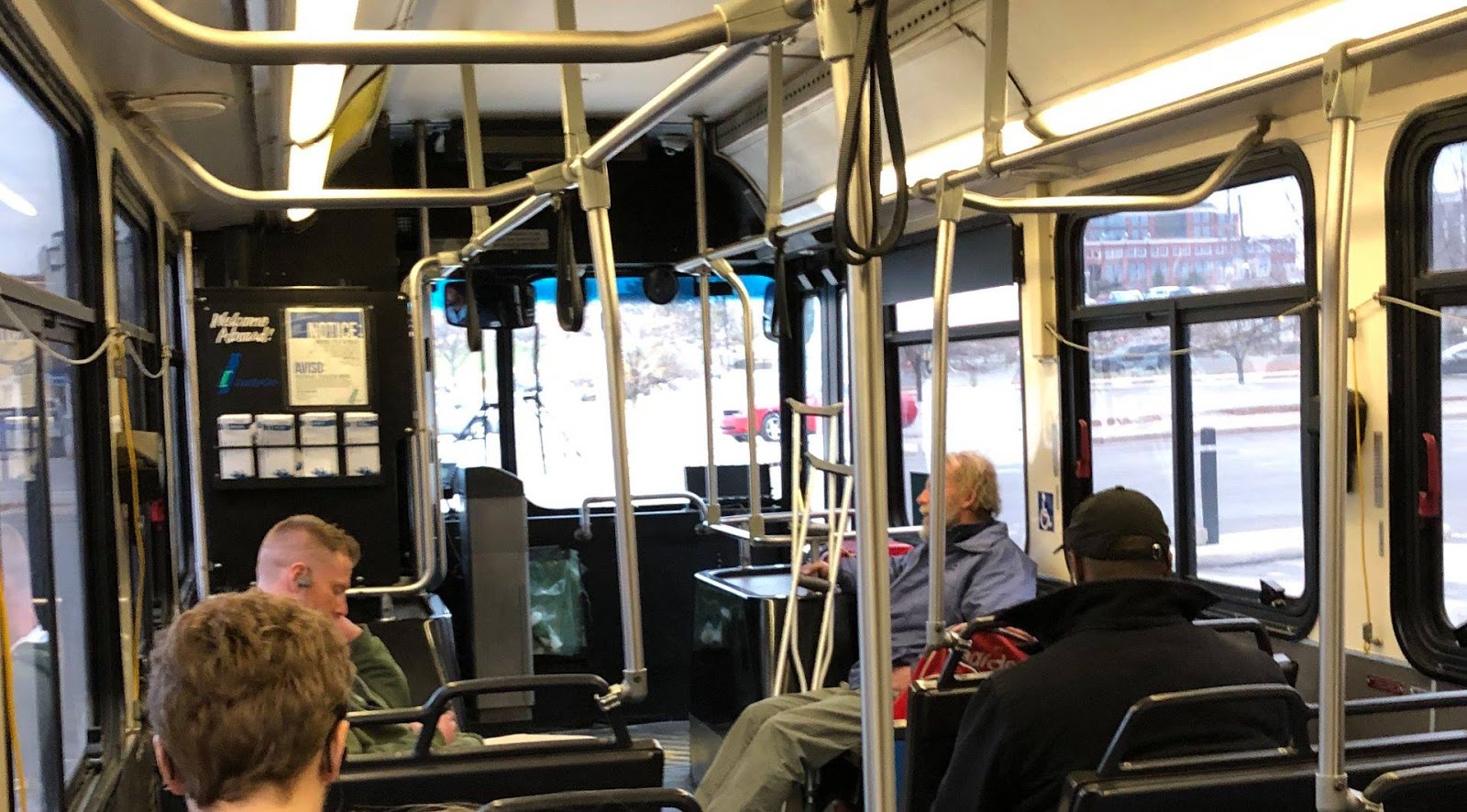
Think your commute is rough? Try driving a bus


It’s not easy being a bus driver, but Bob is glad to have the job.

 “I started with IndyGo after driving tractor-trailers from New York to California. I got tired of being on the road as a truck driver,” he said recently, steering his bus near the end of his route. I’m not using Bob’s real name so he can speak freely, but he’s a friendly guy who enjoys the job and is nice to the passengers.

“I wanted to be home with my family instead of being on the road,” he said. “So when I got into this game it was like, OK, instead of being in a hurry all the time like when you’re driving a truck, I could take my time and take care of the passengers. As Jackie Gleason said, ‘How sweet it is.’”

IndyGo is looking for coach operators as it prepares to start the new Red Line this year and implement a 70 percent expansion in service. The job isn’t for everybody, and the numbers show it. The bus company had 682 total employees at the end of 2018, nearly 20 percent below capacity. In November, the company hired 10 people but lost 11. In December, three left and none were hired, according to a report to the IndyGo board at its January meeting.

The number of drivers isn’t broken out in the report, but Bob and other coach operators say they lose a lot of new hires because dealing with city traffic and angry passengers can be stressful. One woman told me about a passenger dumping a drink on her during a discussion. IndyGo takes passenger complaints seriously, and drivers dread getting written up.

Complaints peak during the summer, maybe because the heat frays everyone’s nerves. July and August saw about 360 complaints each, around double the lowest month, December. Most of the complaints are about “pass-bys,” when the bus doesn’t stop to pick someone up. In their defense, drivers sometimes find it hard to see a person standing in dark clothing at night. Some bus stops cover multiple routes and if someone’s not standing by the sign, a driver might think they’re waiting for a different bus.

IndyGo drivers see a lot. Bob was at a stop light once and looked down to see the driver next to him texting on her phone. The light changed, and her car didn’t move. Bob started to pull away when another car slammed into the woman next to him. He hit his four-ways and pulled over to see if he could help. Both of the other drivers got out of their cars to check the damage - and both were still on their phones, texting.

“You have to laugh sometimes, but it’s also scary,” he said. “We take safety very seriously. People have no idea what we see out here.”

Every organization has problems, but if you ride the bus system in Indy you’ll generally encounter friendly drivers, and will hear riders say “thanks” as they step out the door.

There’s a comment line for riders to speak up. It got 375 total calls in December, including 14 compliments. Most of us never think to jot down a driver number and register a compliment, but maybe we ought to. The number is 317-635-3344.

Indy's paratransit service better, but not there yet


Some good news at last night’s IndyGo board meeting about Open Door.

The Indianapolis paratransit service was running at an on-time rate of 89 percent at the end of December, according to Roscoe Brown, Vice President of operations. That’s compared with 65 percent in August.

WTHR-TV reported in November that the bus company had withheld $960,307 in payments to contractor Transdev for poor service.

Brown said IndyGo has withheld October payments, but released payments for November and December “minus liquidated damages.” Transdev is on track to achieve its contract goal of 95 percent on-time performance, Brown said.

A representative for the company said the improvements had been achieved by adjusting the “run-cut,” or drive scheduling. Peak demand time for Open Door is 7-8 a.m., but most of the drivers were starting work at 9 a.m.

“They had already missed the party,” the representative told board members.

IndyGo is issuing an RFP to look at best practices for providing paratransit service and to make recommendations for improving Open Door. Board members will also be visiting the Transdev operation to better understand how it functions, Brown said.

Elsewhere, President and CEO Michael A. Terry, announced that he is departing the agency.

“After 15 years of service, I’m going to be leaving,” he told the board. “It’s time. The organization is in excellent shape and it’s time to pass the baton.”

Terry, a 1974 graduate of DePauw University, previously was a deputy commissioner for the Indiana Bureau of Motor Vehicles before joining IndyGo in 2003 as Vice President for business development and marketing.

“I’m not leaving right away,” he told the board. “I’ll be here to support the search and the succession plan.”

After the meeting Terry reflected on what the job had meant to him.

“This is a mission,” he said. “We’re doing very important work for Indianapolis, and we’re making progress. That’s very good to see.”


Saturday, January 26, 2019

Looking back: the bus passenger column


Bus drivers to remember a favorite passenger -- and friend


Maude Bryant stood at a bus stop on East Washington Street, about to die.

Amid all the other traffic on that busy street, a speeding Chevy Blazer was headed her way.

She held a box of chicken from the restaurant across the street. She had a monthly bus pass. She probably had a pack of gum to give her bus driver, because that's what she liked to do.

It was just before 2 p.m. on Saturday.

What happened next, you may have seen in the news -- the 76-year-old woman run down on the sidewalk, and the SUV driver charged with reckless homicide and causing a traffic death while intoxicated.

This is about what happened before Saturday.

Maude was her name, but everybody called her Sam. She had the mental capacity of a 12-year-old. You could call that a deficiency, but friends saw instead the smile and enthusiasm of a happy child.

Some of her best friends were city bus drivers. She rode the bus just to have something to do sometimes, and they looked after her.

When Sam had trouble handling her money, driver Jeannie Kemerly stepped in. She organized things and put Sam on a budget, so she could live on her own and not have to go to an institution.

Sam became an honorary member of the family. Because Kemerly's three daughters had boys' nicknames -- Charlie, Oscar and George -- she wanted one, too. And that's how she became Sam.

When Kemerly died last year, one of her daughters, Cheryl Yarnell, took over as unofficial guardian, helping Sam remain independent.

On Thanksgiving and Easter, Sam could usually be found at the home of another IndyGo driver, Rhuperdia Chandler.

"I try to help everybody, but I loved Sam. She was family," Chandler said. "She loved everybody. I've never known anybody like her before."

Chandler heard about the crash while getting ready for church Sunday morning. IndyGo called her at home because police were contacting Sam's family of bus drivers trying to find the woman's real relatives.

She does have a brother and a sister. But both are in other cities and in poor health. So bus drivers were pitching in for a memorial service today.

It's at Shirley Brothers Irving Hill Chapel, 5377 E. Washington St. Visitation is from 5 p.m. to 7 p.m., with a memorial service at 7.

That's only a block from the spot where Sam died. Friends have put up some red and pink artificial flowers and a toy mouse on a utility pole.

Sam had been standing next to the pole, waiting for her bus. The impact from the Blazer knocked her 60 feet. The thought of that made it hard for Chandler to sleep this week. More than anything, she hoped that Sam didn't suffer. Maybe, she hoped, her friend never even saw the truck.

Police said the Blazer was traveling at least 51 mph -- 75 feet per second.

It went onto the sidewalk just a few feet before the pole. In other words, everything happened in a split second.

In a cloud with no silver lining, the friends of Sam had to settle for this:

She lived a good life. Then, thank God, it ended before she knew it.


By John Strauss
The Indianapolis Star
May 2, 2003
 

Thursday, January 24, 2019

Driving in the demolition derby


(This was a first-person sidebar to a national story on derbies, the kind of crazy night on the job that sticks with you a long time later. When I was an AP correspondent, the occasional feature like this was a welcome break from some of the serious coverage of disasters we were often assigned. (A look at some more typical stories: http://tcom610.blogspot.com/2011/01/some-of-my-stories.html)

Novice drive takes his shot in demolition derby at fair

(John Strauss, the AP’s Evansville correspondent, drove a demolition derby car at the Posey County Fair and lived to write about it.)

NEW HARMONY, Ind. – Joe Downs had the car ready for the demolition derby: the windows and all but one of the seats were out, the hood was lashed down good and the doors were chained shut.

“Don’t be nervous,” he said, watching me fumble with the straps on the crash helmet. “Remember, if the engine catches fire, climb out on the roof. If the fire’s inside, go out on the hood. Whatever you do, don’t get off the car or you’ll get run over.”

Some choice: Say with a flaming 1977 Dodge Monaco or try running through a dozen rampaging jalopies doing their best to wallop each other.

“Just give them a good show,” said Downs, who works at the Evansville junkyard where the car was bought for $35. He taught me the basics:

Reverse gear is important in a demolition derby. Hit other cars with the back of your car to protect your radiator. Try to bash in somebody else’s front end and take out their cooling system. With luck, you can hide in the clouds of steam from exploding radiators.

But the Monaco’s jury-rigged shift stick jammed at the start, trapping my car against the telephone poles laid down to circle the field. Off the passenger side a station wagon hurtled backwards toward me.

BAM!

The Monaco shuddered violently and then shook clear, full throttle in reverse, toward the center of the cfield with the station wagon in pursuit.

BAM!

A three-car pileup in heavy traffic near the middle killed the Dodge’s engine. The car had to be hot-wired using cables on the floor as the sedan jerked back and forth under the pounding of the battles around me.

My car’s engine finally started and I was able to get away and take a couple shots of my own. I feinted, jabbed, parried, got some good contact and started to get the feel of it.

The Dodge somehow made it to the final round but got hammered badly there, eliminated finally when the driveshaft broke on one of the telephone poles.

If there was one bright moment, one glimpse of the thrill the regular drivers get out of this mayhem, it came early on – as I scrambled to keep from being disqualified for not hitting another car within the time limit, two minutes.

As the announcer was telling the crowd I only had seconds to go, the Dodge leapt forward, picking up speed toward a slow-moving car 40 yards away.

Time was almost out. The crowd, knowing this was my first derby, was cheering and I felt like a high school kid sprinting for the end zone.

I made the play, creaming the station wagon head-on to stay in the game.

The crowd roared. The head-on crash wasn’t smart – but it was a good show.

Aug. 7, 1987

Wednesday, January 23, 2019

Cab driver Steve the Hippie


I went to Albuquerque in 2009 to speak to the New Mexico Press Association and met a loquacious cab driver on the way to the hotel. The creative challenge was to help tell his story. Or stories. (He had a lot to say.) Beneath the gruff, slacker exterior was a bright guy with a lot of pride in how his daughters turned out. You'll see him swallow hard after he talks about them. Next question.

Monday, January 21, 2019

Things you can learn in prison


A long night at an Indiana prison riot offered a good lesson in journalism and human relations when I was on the street years ago.

This came up recently when I came across my story dictated from a telephone booth at the Indiana Reformatory at Pendleton northeast of Indianapolis.

Here's the top:

PENDLETON, Ind. - Authorities today regained control of a prison block where knife-wielding inmates rebelled in protest of conditions, injuring five guards and holding two others hostage for more than 15 hours. A third hostage was released earlier.

The last of the guards was released shortly after midnight Friday after Department of Correction officials agreed to meet some of the prisoners' demands.

"I'm OK," said one hostage, corrections officer Carl Ingalls of New Castle, as he waited early today at the Indiana Reformatory entrance for his wife.

Five guards were hospitalized with stab wounds, with one listed in very serious condition, authorities said...


Things I remember about that now:


- Somebody told me that night that the guards at any prison only have control of the place as long as the inmates let them. The inmates generally comply because they get to run the society inside, and any rebellion usually brings a very tough response. At Pendleton that night, the inmates had enough control to force administrators to negotiate. And they figured out what conference room we in the media were filing from. Soon they began calling the phone to tell us directly about their complaints. They were smart, organized and very violent.

- For a reporter on the scene there were challenges that hardly exist today. Laptops were rare so we dictated stories and updates by telephone. You did that by assembling your notes and quotes, writing yourself a lead to get started and then weaving the rest of the narrative together as you went. That's a skill that could be helpful again today when we're talking about frequent Web updates.

- We had no cell phones, so to file an update we had to use the pay phones in the lobby (after administrators disabled the conference room phones we had been using, because the inmates were calling us). There were just three pay phones. As midnight arrived and it appeared the inmates were about to release their hostages I grabbed one of the pay phones and called my office, holding the line so I we could get the update out right away. Other reporters did not like this, so I pretended to be in a heated conversation with somebody at the other end. As soon as the last hostage was released we hit the wire in time for morning newspapers that had been holding their pages.

- Don't freak out your sources. After the prison was secured again we naturally wanted to talk to some of the correctional officers who had been held hostage. No way, administrators said. They were a bit shaken up and were still being debriefed anyway. An hour later I was still on the scene, in the tradition of wire service reporters who have to stick around well after the cycle closes in case there are questions. The TV cameras had packed up and the place was clearing out when I saw a door open and a young guy in his 20s walk out. He wore the uniform of a correctional officer but his tie was askew, his hair mussed and his face pale and haggard. I sidled up to him.

"You OK?" I said.

"Yeah, I'm OK," he replied.

"You were one of the guys they were holding hostage?" I asked gently.

He nodded and told me his name, and then we both looked up. A frantic, wild-eyed man ran up to us - one of my competitors from another wire service.

"Hey! Are you one of the prison guards?" he said in a loud voice. After the very quiet start of our chat it sounded like this guy was yelling. My guard lowered his head and mumbled that he had to go meet his wife. The interview was over.

That moment with the former hostage was brief but it made the third paragraph of our national story. It was also a great lesson in human relations. My colleague hadn't meant to blow the interview: Had he been cool and just eased into the situation we could have both gotten a first-person account from inside the riot.

The gentle touch often pays off. That's a principle that's worked in a lot of situations far from the prison over the years.

- John Strauss, jcs1122@yahoo.com

Saturday, January 19, 2019

Jules Loh


(AP Photo)

(From 2010)
Jules Loh, retired great AP feature writer, has died. Read his AP obit here: http://www.startribune.com/obituaries/101746968.html

Here's his famous, 600-word profile of revenue agent "Big Six" Henderson:


BIG SIX HENDERSON

BY JULES LOH
Associated Press witer

LOUISVILLE , Ky. (AP) - In Kentucky‘s moonshine hollows, one name still strikes awe: Big Six Henderson

Big Six Henderson busted up more stills in his time than anybody in history. If that is not so, at least it is the legend. When moonshiners talk about Big Six Henderson, the line between truth and legend blurs.

“I don’t know what the record is,” Big Six Henderson allowed, thinking back on his days of prowling around in alien corn.

“I know I raided more than 5,000 stills and sent more than 5,600 moonshiners to prison. You could figure it up. I’ve kept a copy of my daily reports for every day I was a revenue agent.”

That was for a span of 28 years until he retired a few years ago, and it figures up to roughly a still every other day. The saga of Big Six Henderson, though, is hardly told in dry statistics.

The moonshiners Big Six Henderson tracked down imparted heroic dimensions to him and respected him as much as they feared him.

“Mr. Big Six,” one woman said when he came to haul her husband off to jail for a third time, “we’re proud to have folks know we know you.” More than a few moonshiners named their children for Big Six Henderson.

One even named his mash barrel for him, painted “Big Six” on it and talked to it fondly.

“Good morning, Big Six,” he said to the barrel one day. “Why don’t we just run ourselves off a little batch, you and I. What do you say to that, Big Six?’’

“That you’re caught, Thurlow,” Big Six Henderson said, stepping out of the mist.

At 75, Big Six Henderson is still impressive to behold. He is a bear of a man, 6-foot-4, with a think bush of white hair and eyes the color of wet turquoise. His mother named him William; Big Six was the name he picked up when he was going to law school and throwing a baseball after the fashion of Christy “Big Six” Mathewson.

His career as a lawyer was a rapid as his fastball.

“My first and only case was defending a guy who broke into a warehouse. He was guilty as hell, but I got him off. I decided if I had to make a living that way I might as well be a holdup man and at least be honest about it.”

There is nothing complicated about Big Six Henderson’s sense of justice.

So he became a federal treasury agent, a “revenooer” as they are known in the hills, and went it with a single-mindedness that became the stuff of myth.

Big Six Henderson can smell a still from 10 miles off. “Actually about two miles if the wind is right,” Big Six Henderson corrected. Big Six Henderson can shoot a pistol out of your hand at a hundred yards. “Well, the way that got started was by accident. I was aiming at the man’s belt buckle.”

It was no myth, though, that he could creep through the woods as quiet as smoke in his green raiding suit and could run like a deer for miles. Usually he didn’t have to run after his quarry.

“Homer, halt!” he shouted at one fleeing moonshiner. The man froze in his tracks.

“I’m halted, Big Six, I’m halted.”

He was a legend in his time, all right, and not just because of his uncanny skill and his zealotry. He also has a reputation for fair play and decent treatment of the moonshiners he caught.

“I never regarded them as doing something evil, just illegal,” Big Six Henderson said, “and I never abused them.” The big man thumbed through a sheaf of his faded daily reports, looking wistfully at the names.

“Killed a few, but never abused them.”

Sunday, February 25, 2018

Writing still a top skill in a digital world - survey

Photo: Byteback.org

People seeking jobs in the media must have solid abilities as writers and editors even while eyeing video and emerging technologies that could change their industry, a survey of a LinkedIn media group shows.

And the survey of more than 200 content creators and editors from news and public relations depicts a growing interest in data journalism, coding and content management systems.

“Learn how to shoot and edit video -- the media industry is increasingly incorporating video into its storytelling, so that's a valuable skill,” said one member of the LinkedIn group Online Reporters and Editors, where the online survey was based.

“Also, develop your writing skills for both digital and broadcast. By that, I mean, don't just be a writer -- be a GOOD writer. Learn how to use words creatively and actively and learn how to establish and sustain a point or an argument.”

Those primarily in online media accounted for 62 percent of the respondents. Print accounted for 24 percent; 9 percent were from broadcast and 5 percent not in media.

Also from the survey, among those who work in media:

- 56 percent were content creators
- 39 percent edit the work of others

- 42 percent were managers
- 53 percent not managers

- 82 percent said their primary skill was in writing or editing
- 5 percent cited, video
- 2 percent, audio
- 2 percent, still photography
- 9 percent said they were not content creators.

- 74 percent work n news
- 11 percent PR
- 15 percent neither

Asked how they would rank media skills in importance for job seekers, 95 percent said writing and editing were top skills; 82 percent listed video; 48 percent said design and 43 percent, audio.

The survey showed 68 percent said it was very important to learn video skills; 30 percent said somewhat important.

Despite the strong showing for emerging media and online abilities, many respondents said jobseekers should emphasize the basics as well:

“Be hungry. One of the things that really makes candidates stand apart is their passion to tell stories or do good work,” one group member said. “I want reporters to be good researchers and writers, but the most important quality is that strong desire to dig, learn and discover new angles and stories.
Also, look for new ways to tell stories, whether it's through multimedia, podcasts, Facebook Live...anything.”

From another member: “Proof of ability to write and/or edit is paramount. Video, social, etc., are all bonus points, but writing skills trump all.”

And: “Learn the (AP) Stylebook inside and out. Come armed with good story ideas. If you can't find a job in media, keep freelancing, someone will notice and hire you eventually.”

Other respondents urged newcomers – and veterans – to understand search-engine optimization, social media skills, content management systems, and be versatile, in other words.

The final question in the survey asked for any advice that group members might want to pass along. Here’s a selection of those comments:

- Editors, colleagues and institutes like Poynter can help you discover new skills. Always look for classes or people who can help you.
- Students need to know what's happening in the news, so they have to read, watch and listen to news daily. They need to be able to write a coherent sentence. And they need to know how to verify a fact.

- Learn as wide of a variety of skills as you can. Wear many hats, and don't be afraid to raise your hand to learn new things. Always be forward-thinking and innovative.

- Learn media ethics. no matter what medium, you need ethical standards. your credibility is all you have.

- Look for a job in another industry.

- Go into print to learn the basics and then leave after five or so years and go to electronic media.
- Experience outside of media is a plus (in addition to media), and strong writing and editing skills are crucial as well as a willingness to learn and adapt to an ever-changing work environment.

- They should focus on video journalism (shooting, write a script, editing, publishing) and they should know more about web videos and storytelling.

- Become an expert in some area rather than attempting to be a master of all.

- Learn analytics, video and audio editing skills, and data visualization too

- It's a very tough industry to get into and stay in, but keep updating your skills and on top of the latest technologies and trends to keep yourself relevant to your current and future employers.

- Reporting, writing and the ability to find good stories is No. 1. Period. Also, read NYT, WaPo, LAT and study how stories are put together. Look at structure. Understand the importance of the interview. Know how to get the "get." After that, they need visual skills, especially video. If they understand their way around data, database reporting also is important. Also, they have to understand the cadence and tempo of a newsroom. They have to be able to multi-task. The nimble reporter who can pivot is extremely valuable. In a way, it's about being a generalist, but highly competent in everything they do not just good at a lot of things.

- Please make sure you find employers that will give you opportunities to take classes to improve or upgrade any knowledge you already possess. Too many employers expect candidates to know software and do not look at the person who has the experience in the field and the right attitude about work.

- I would add data visualization and the combination of the above-mentioned skills for multimedia storytelling. I think digital media job seekers should be more open to innovation, embracing new technology, and be better at creative problem-solving. While hard skills are still needed, soft skills are equally important.

- Put yourself out there! Be on social media, network and talk to people. Make connections. Take chances, but also remember what you're worth. It's difficult to find a great job with benefits, but it's possible.

- I'm old school, but today's students need to become excellent at multi-media approaches to their work - audio, video in addition to their writing abilities. They must have curious minds and be thorough in their approaches to stories, looking to check as many sources as possible to get it right even it means not getting it first.

- In my opinion hard-nose reporting is vital. So is stylebook knowledge. I ran a daily online newspaper in Costa Rica for 17 years and have just retired. I hired a lot of interns. The job was not beaches and frosty drinks. Nearly all of my interns faced armed robbers. Communicating to English speakers there and in the States is a challenge. I also think new hires shoujld have guts and know a little about advertising, enough so that advertisers do not affect the news report.

- Learn coding skills

- You have to be curious, not just when you're being paid to be but all of the time. You have to sweat every tiny detail. You have to respect your audience or they will drive you crazy (and vice-versa). "Sacred trust" might seem strong words, but if you go into this profession just because you think you are a good writer, or because you like attention, you will be miserable. If you go into it thinking you can glide through and get your stories "mostly right", please stop right now. Because we've all worked with that guy or woman and they don't just produce sloppy work, they make it that much harder for the rest of us to do our jobs. But if you really feel called to do this work, there has never been a better, more exciting time to be a journalist. Tools are changing, expectations have never been higher, the need for accurate information has never been more acute. If you love it and you work hard you can make a real difference. We need smart young journalists more than ever before.

- The fact that unpaid internships are standard in our industry is unfortunate--however, i think they can be more important learning experiences than J-school. (Cheaper, too.)

- They have to be Multimedia storytellers and engage more on Data and Geo-Journalism because are trending stuff where media industry is going in terms of technological agility. Specialization is also important to build credibility and uniqueness in the employment market

- First of all -- guys, wear a dress shirt and tie; ladies, a dress, nice skirt and blouse or equivalent. Over the last 10-15 years, the professionalism of reporter and editor candidates has fallen precipitously.
In 2004, the first year I was responsible for hiring news staff at the newspaper I worked at, about 80-90 percent of candidates came dressed professionally. Today I'm lucky if I get 30 percent. I know times have changed and we're all generally a bit more casual in the workplace, but look at it this way. You wear a dress shirt and tie and everyone's in jeans and polo shirts, so what? If anything, they'll appreciate the effort. You wear jeans and a polo shirt and everyone is in business dress, you can pretty much kiss that job goodbye.
Second, if you are in J-school, you should insist the department offers a class in basic reporting skills and a class in basic writing/grammar/story structure skills. Again, in the last 15 years, the "test" stories I get back from applicants today have dropped to where 90 percent would make the cut back in 2004, to literally 15-20 percent. Same story, same test, graded the same way, so it's not like I've become inflexible and hard-nosed with impossible expectations in my "old age" (I'm 51.)
And even some of those we do hire have no idea how to report a story, much less report it aggressively. J-schools are teaching students all about "content" for the web, social media, multi-media, video, audio, slideshows, analytics, metrics and on and on. All that is great -- I'm all for it. Unfortunately, they haven't continued to teach the fundamentals (high schools and middle schools have slacked off on this as well, but that's a different story.
            All the web and social media skills in the world won't mean a thing if you can't put two sentences together and write a compelling news story or feature. And believe me, many, many J-school grads I see cannot do either. Seriously.
The best candidates today are the ones who come in with a sound education in writing and reporting fundamentals, hopefully experience at a college paper, weekly or small daily, PLUS all the digital and new media skills.
If you have all that, dress professionally, address the interviewer by "Mr." or "Ms.", answer their questions honestly and openly and make sure YOU have questions of your own -- the best are those that ask about the interviewer (how long have you worked here, what do you like about it, what's your career been like, where'd you go to school, etc. -- you'll be in good shape.
0-0

Any surprises? What has been your experience, either in hiring or in job searches? Tell us what you’ve seen, what it was like and what you’ve learned.

John Strauss is the founder and moderator of Online Reporters and Editors, a LinkedIn group for people who create and edit online content and are interested in media convergence and related topics. He is a former newspaper reporter, university journalism instructor and student media adviser who has managed public broadcasting facilities, produced public media programming and was a correspondent and manager for The Associated Press. He has presented to news and public relations groups across the country on mobile video and content creation strategies, and currently works in strategic communications in Indianapolis. Contact: johncstrauss@gmail.com/.